Embark on a journey of knowledge as you navigate through our rich collection of articles.
Why Leather Hides and Multilayer Gaskets Need Different Digital Cutting Workflows
10/13/2026
Amanda Ye
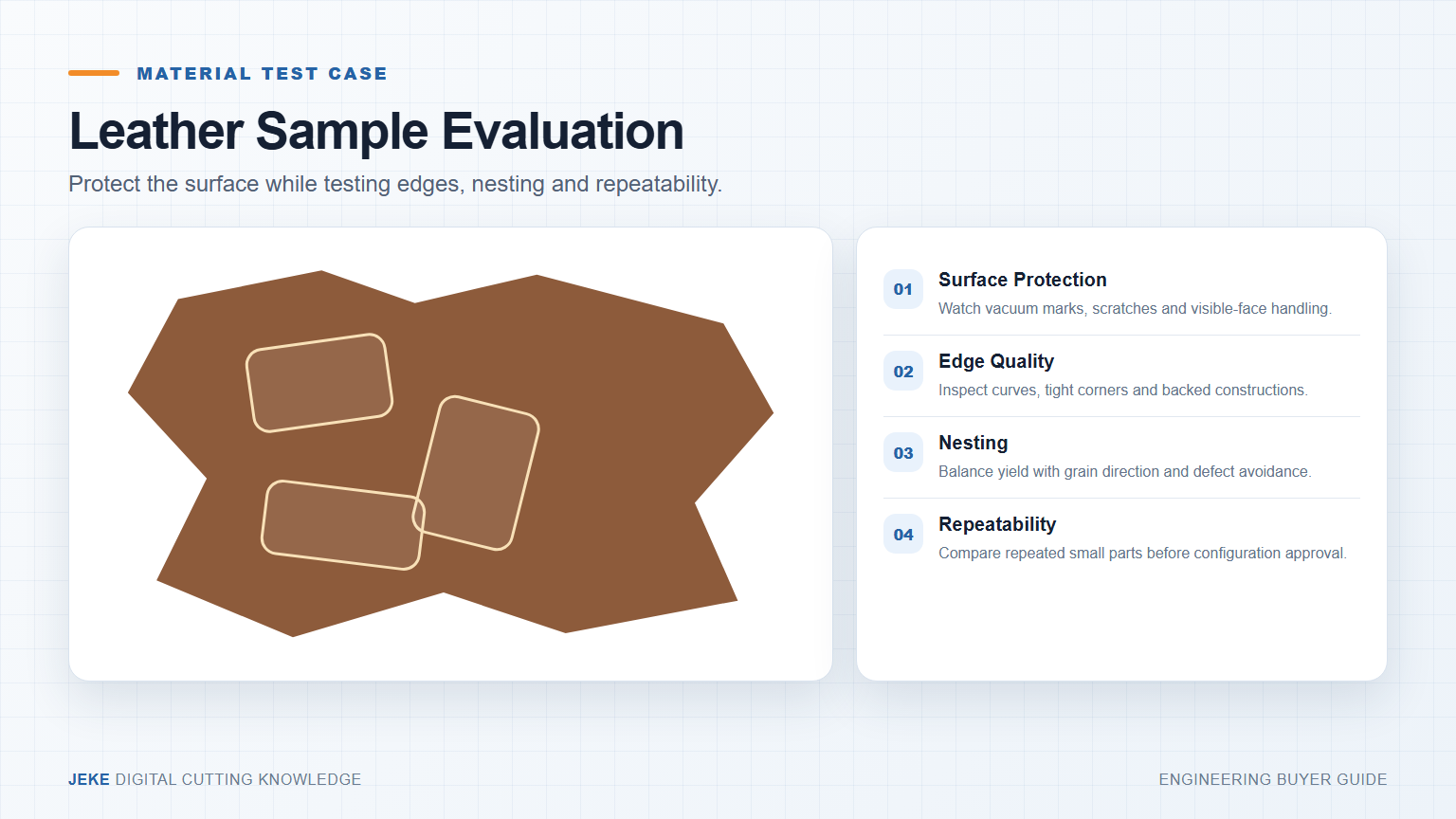
Leather hides and multilayer gaskets should not share one generic digital-cutting specification. Leather variation often centres on hide outline, natural defects, quality zones, and placement choices. Gasket variation centres on material identity, layer stack, orientation, compression, repeat geometry, and traceability. Each application needs its own data, planning, holding, cutting, inspection, and acceptance pack.
Start with the source of variation
For leather, record hide geometry, thickness variation, stretch, finish, defects, and quality zones. For gaskets, record each layer, batch, orientation, thickness, adhesive or backing, compression sensitivity, and drawing revision.
Define different input data
A leather workflow may require a hide image, operator-marked defects, quality grades, part-placement rules, and order priorities. A gasket workflow may require controlled CAD revisions, material-stack records, batch identity, part numbers, and traceability fields.
Camera registration does not automatically mean defect detection. Likewise, nesting software does not automatically enforce gasket layer identity. Each capability must be named and demonstrated.
Define different planning logic
Leather planning may aim to place parts around defects and assign quality zones while respecting grain or appearance. Gasket planning may prioritise orientation, material utilisation, repeat geometry, kit identity, and batch control. These are different decision rules even when both use digital files.
Workflow element
Leather hides
Multilayer gaskets
variation
outline, defects, zones
stack, batch, orientation
input
hide/defect map and parts
drawings and material records
planning
place around quality limits
control layers and repeat parts
inspection
defect use, edge, appearance
dimension, layer integrity, identity
traceability
hide/zone decision
batch, layer, revision, kit
Define holding, cutting, and inspection separately
Actual material behaviour determines tool and hold-down requirements. Leather may stretch, curl, or mark; gasket materials may compress, shift, separate, or carry sensitive liners. Test the exact material and inspect the qualities that matter to that application.
Build two validation packs
The leather pack should include representative hides, annotated defects and zones, part files, placement rules, accepted examples, and operator decisions. The gasket pack should include the complete stack, drawings, revisions, batch records, orientation, identification rules, and inspection criteria.
Avoid unsupported automation claims
For every proposed function, state whether it is standard, optional, third-party, model-specific, or unavailable. Require a live workflow demonstration and versioned evidence. Competitor descriptions show that such workflows exist in the market; they do not prove JEKE provides them.
Frequently asked questions
Can one nesting method serve both applications?
Not reliably without application-specific rules. The inputs, constraints, quality decisions, and traceability needs differ.
Does camera registration equal defect detection?
No. Registration, contour capture, defect detection, classification, and placement logic are separate capabilities that must be verified.
What belongs in each acceptance test?
Actual materials, controlled data, configuration, operator steps, acceptance criteria, limitations, repeat results, and traceable evidence for that application.
Next step
Choose one real application and submit its material, data, files, and acceptance criteria to JEKE for a model-specific applicability review. Cross-industry automation is not promised.