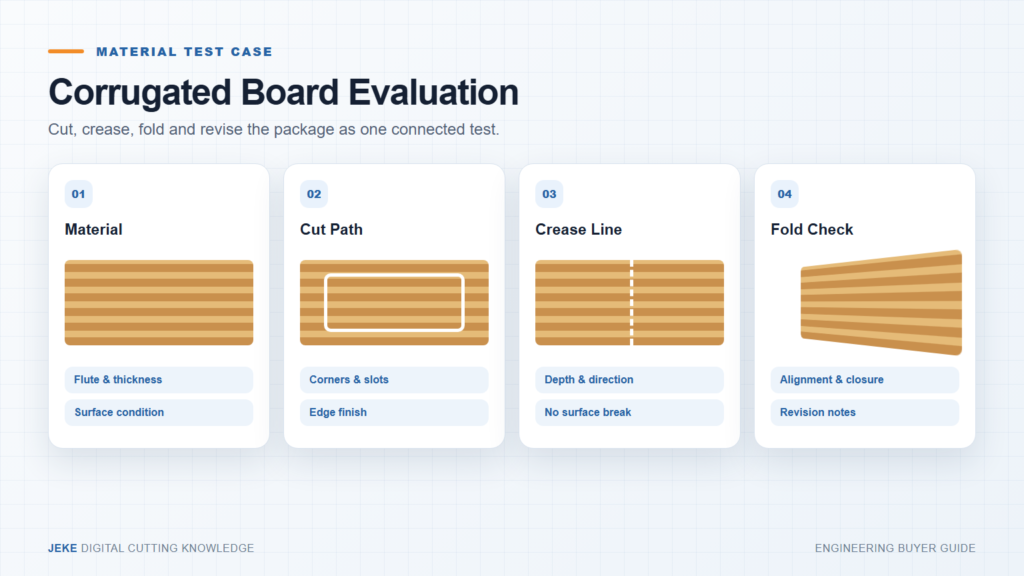
Direct answer: Choose a corrugated-board creasing wheel by testing the actual board construction, flute type, liner, crease direction, fold requirement, wheel diameter and profile, pressure or depth, speed and backing condition. There is no universal wheel or pressure for every board. The accepted setup is the one that creates a straight, repeatable fold without unacceptable liner cracking, board crushing, delamination or spring-back.
Packaging teams often treat creasing as a secondary operation after cutting. In practice, a sample can have an accurate outer contour and still fail because the fold is weak, crooked, crushed or visibly cracked.

Identify the board before choosing the wheel
“Corrugated cardboard” is not a complete specification. Record enough information to repeat the test:
- Single-wall, double-wall or other construction.
- Flute type and total measured thickness.
- Liner and medium information when available.
- Coating, print, lamination or recycled-content variation that may affect cracking.
- Machine direction and flute direction.
- Material batch and conditioning before the test.
Different flute sizes and paper combinations respond differently to local compression. Industry tool portfolios therefore use different creasing-wheel sizes and tools for solid board, single-wall corrugated and heavier multi-wall material.
Flute direction changes the crease
Research on top-side corrugated creasing shows that orientation relative to the flutes and the wheel’s position over the flute structure can influence tearing and fold behavior. A packaging drawing may contain creases parallel, perpendicular and diagonal to the flutes, so a test in only one direction is incomplete.
Prepare coupons in at least the production directions. If the box layout allows the sheet to be rotated, test the alternative orientation too. Higher material yield is not useful if the chosen orientation creates an unacceptable fold.
Build a controlled test matrix
| Variable | What to hold constant | What to inspect |
|---|---|---|
| Crease direction | Board, wheel, pressure/depth and speed | Straightness, liner damage and fold force |
| Wheel diameter/profile | Same board and crease line | Crushing width, fold definition and waste at run-in/out |
| Pressure or depth | Same wheel and orientation | Under-creasing, cracking, crushing and delamination |
| Speed | Same material and tool setup | Consistency and dynamic board movement |
| Backing/table condition | Same upper process | Support, impression and repeatability |
| Printed/coated face | Same structural board where possible | Visible cracking and surface damage |
Change one primary variable at a time. Label every coupon before folding, and keep the original flat coupon linked to the result. If several variables change together, the team cannot identify which change improved the crease.
Inspect more than the visible crease line
A complete inspection includes the flat board, the first fold and the folded structure after a defined waiting period. Record:
- Top-liner cracking or tearing.
- Excessive flute crushing outside the intended crease zone.
- Delamination between liner and medium.
- Fold straightness and whether the panel follows the intended line.
- Spring-back or opening after folding.
- Visible damage to printed or coated surfaces.
- Interference with slots, tabs, glue flaps or other nearby features.
Define pass/fail by the package, not by a generic appearance
A display panel, shipping carton, protective insert and sample box can have different acceptance standards. Agree on the fold angle, visible-surface requirement, assembly method and structural use before testing. Where practical, convert the full sample and assemble it instead of approving an isolated crease coupon only.
If the digital sample will be used to validate a later die-cut product, use the intended production substrate. A thin substitute may produce a clean-looking mockup while hiding the behavior of the actual board.
Match the tool to the board category
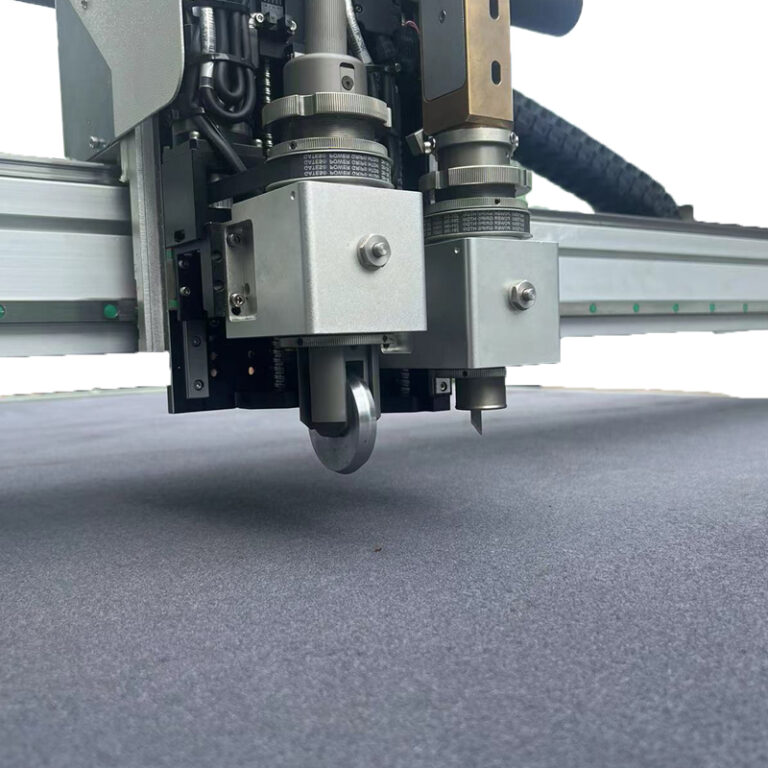
Tool manufacturers distinguish among universal creasing tools, tools intended for single-wall corrugated board and larger tools for double- or triple-wall material. This does not mean that a category label automatically selects the final wheel. It means the buyer should begin with a suitable tool range and then validate the result on its own board.
Ask the machine supplier to identify the wheel, tool, process settings and board used in every sample. A photograph without this information cannot become a production recipe.
Recommended corrugated crease-test record
| Record field | Example of the required detail |
|---|---|
| Material | Board code, construction, flute, thickness, coating and batch |
| Orientation | Crease direction relative to flute and machine direction |
| Tool | Creasing tool and wheel identification, diameter and profile |
| Settings | Pressure/depth, speed, path direction and backing condition |
| Result | Flat-line appearance, folded result, cracks, crushing and spring-back |
| Decision | Accepted, conditionally accepted or rejected for the defined package |
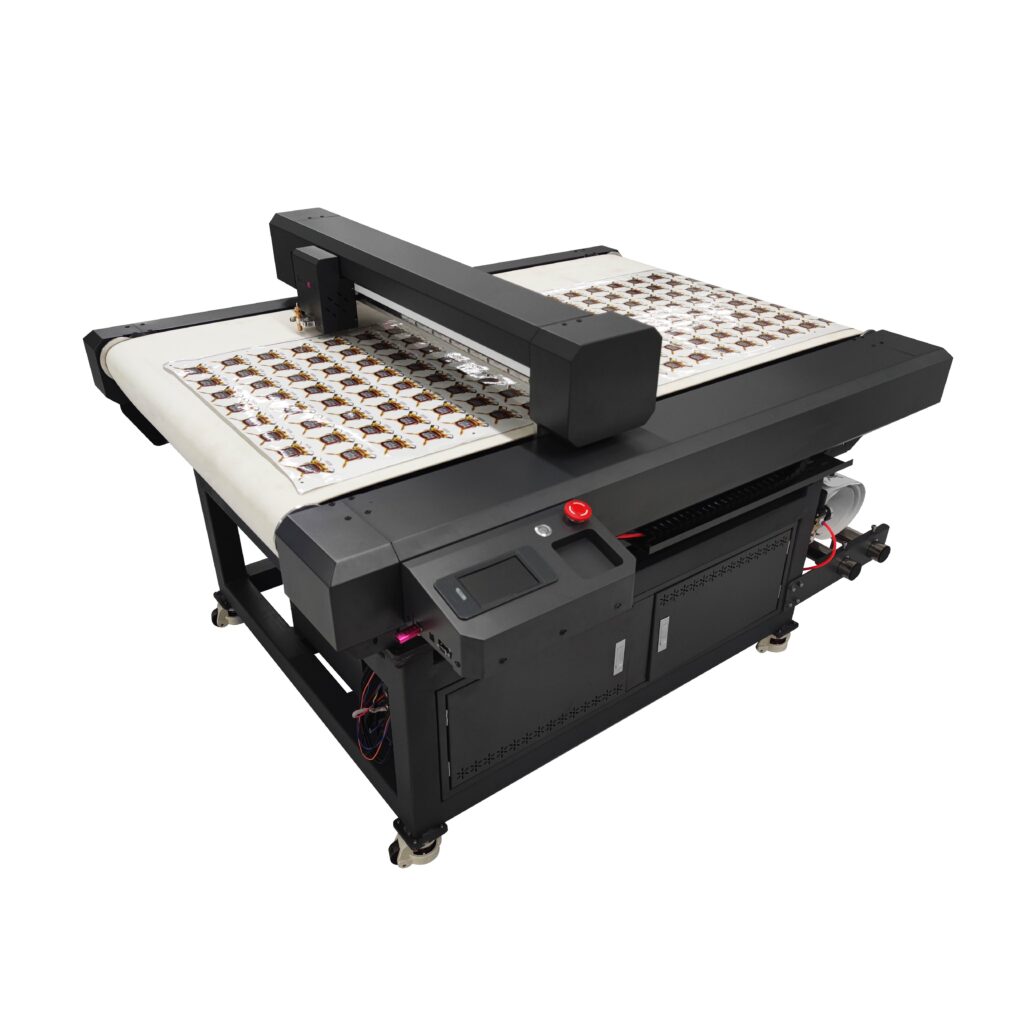
Extend the crease test with JEKE's 2516 cardboard box cutting machine page, packaging prototype cutting workflow, and corrugated cardboard cutter buyer guide.
How JEKE can support a corrugated-board test
JEKE digital cutting systems can be configured for corrugated cardboard, cardboard, grey board, honeycomb board and other packaging or display materials, with cutting and creasing tools selected for the application. The wheel and settings should be confirmed with the actual board, flute direction, dieline and fold requirement.
Request a corrugated board cutting and creasing test from JEKE and include the board specification, printed or unprinted sample, dieline, fold direction and acceptance standard.
Frequently asked questions
Is a larger creasing wheel always better for corrugated board?
No. Wheel size and profile affect crease behavior, required space and run-in/run-out. The appropriate choice depends on board construction, fold requirement and the complete package geometry.
Should creasing be tested parallel and perpendicular to the flutes?
Yes, if both directions occur in the package or the sheet orientation is not fixed. Direction can change the risk of tearing, crushing and an uneven fold.
Why does a crease look good when flat but crack after folding?
The flat impression does not show all strain applied during folding. Liner, coating, paper condition, crease depth and direction can influence cracking. Always inspect the folded result.
Can one setting be saved for every batch of the same board?
A saved recipe is a useful starting point, but material batches and condition can vary. Use a first-piece check and update the recipe only after documented verification.
Sources and further reading
- Procedia Manufacturing: Inline corrugated board creasing
- Zünd: Creasing tools and inserts for packaging materials
- Zünd: Creasing tool categories for solid, single-wall and multi-wall board
Last reviewed: August 20, 2026.