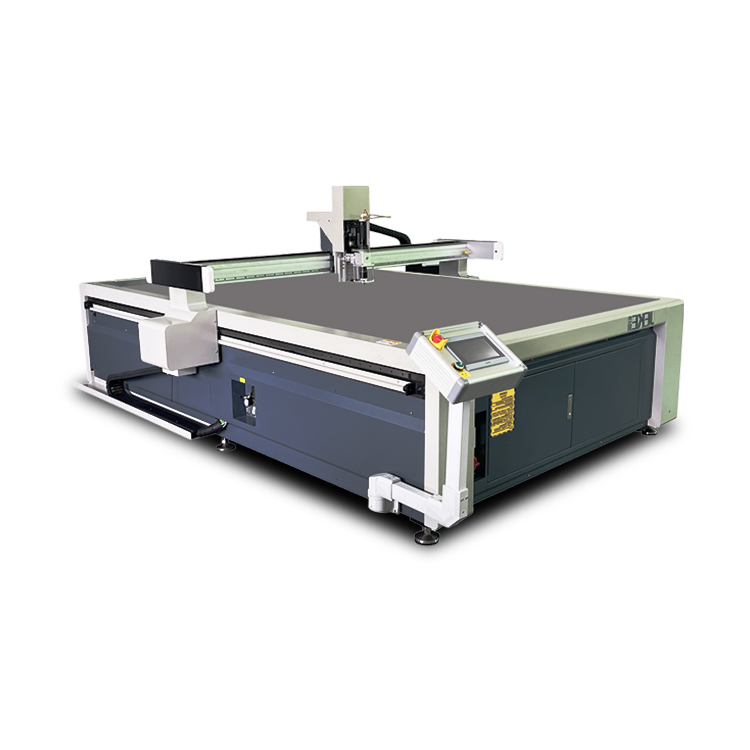
Direct answer: Automotive carpet, felt, foam and leather should not be assigned one cutting tool based only on their names. Test each material’s thickness, density, fiber structure, backing, compressibility, visible-face requirement and smallest feature. Oscillating tools are common for many dense or fibrous materials; rotary tools can suit selected fabrics and lighter textiles; punching and marking tools may be added for assembly features. The final choice must be confirmed on the production material.
An automotive interior cutting cell often processes materials that look related but behave very differently under a blade. A soft acoustic felt may be porous and difficult to hold. A carpet may have a tough backing. A foam may compress before the blade reaches the bottom. A visible leather panel may cut cleanly but still fail because of a surface mark.
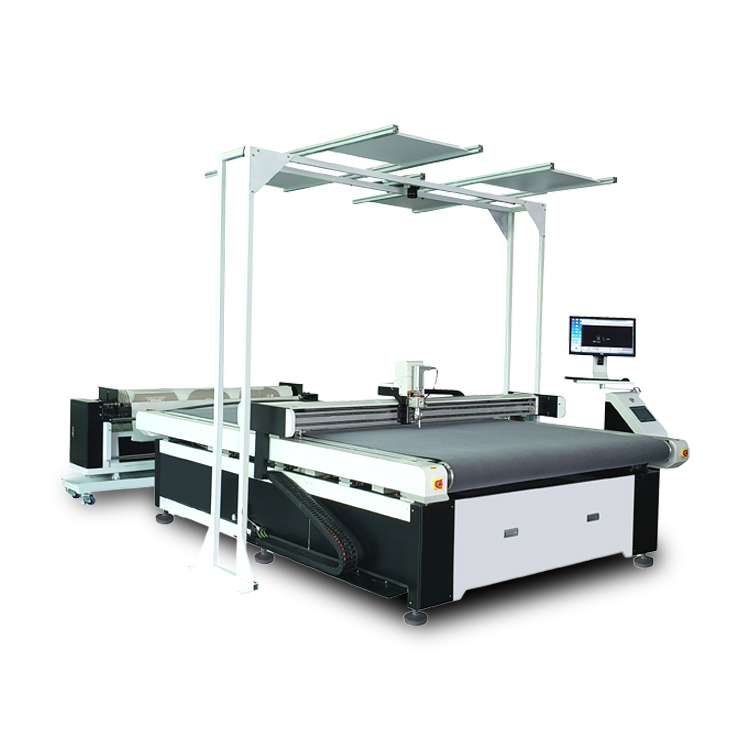
Choose the tool by material behavior
| Material behavior | What to investigate | Likely test direction |
|---|---|---|
| Fibrous and porous | Fiber pull, fuzzy edge, vacuum leakage and small contours | Compare a suitable oscillating or rotary process and improve hold-down |
| Dense or tough | Blade force, heat from friction, deflection and incomplete separation | Test a more powerful oscillating tool and appropriate blade geometry |
| Soft and compressible | Compression, depth control, blade length and narrow-feature distortion | Test tool stroke, blade support, cutting depth and number of passes |
| Coated or laminated | Layer separation, coating lift, backing drag and edge whitening | Test the full laminate, not one layer in isolation |
| Visible surface | Scratches, vacuum marks, pressure marks and unwanted annotation | Test face orientation, protective layer and clean handling |
| Thin film or skin | Stretch, lift, kiss-cut depth and liner condition | Consider drag or other suitable thin-material tooling where applicable |
These are test directions, not a universal tool chart. Official tool guides from established cutting-system manufacturers also qualify recommendations by material thickness, density and application. Even within one tool family, stroke, blade thickness and blade geometry can change the result.
Automotive carpet: test the face and the backing
Identify the pile, backing, total thickness, stiffness and largest part. The top surface may hide a poor cut at the backing, so inspect both sides. Include long outside curves, fixing holes, notches and the tightest inside corner used in production.
Carpet can also create high blade resistance and debris. Record whether the part releases without manual trimming, whether the edge sheds fibers and whether the hold-down remains stable during long contours. If punching or marking is needed for attachment or assembly, test the combined operation in the actual sequence.
Felt and insulation: control porosity and small features
Felt and acoustic insulation may allow air to pass through the material, weakening vacuum hold-down. The test should document active vacuum zones, covered unused table area, any overlay and the direction of material movement if shifting occurs.
Use a feature coupon with small holes, narrow channels and internal corners. Inspect for fuzzy edges, pulled fibers and loss of contour. A clean long cut does not prove that a dense cluster of small automotive features will be acceptable.
Foam: thickness alone is not enough
Foam selection must include density, hardness, cell structure, elasticity, lamination and required wall shape. Two foams with the same thickness can require different blades or process settings. Test whether the foam compresses, drags, rebounds or closes over the cut.
If the part is thick, inspect the top and bottom profile for taper or deflection. JEKE’s published 100 mm capability is limited to suitable sponge, foam and EVA on the JEKE-2516 with an appropriate tool and configuration; it must not be generalized to every automotive foam or composite.
Leather and synthetic leather: protect the visible face
Record whether the material is natural leather, PU, PVC, microfiber or a laminate. Test grain or stretch direction, backing, coating and quality zones where relevant. The cut must satisfy edge, dimension and surface requirements simultaneously.
For seat and trim parts, include paired components and any matching rule. Inspect for pressure marks, scratches, coating lift and incorrect placement across defects. If identification marks are proposed, confirm that their position and medium are acceptable for the next process.
Build one test coupon that exposes tool limitations
Use the same diagnostic geometry on every candidate material, then add a real production part. The diagnostic coupon should include:
- A long straight cut in both material directions.
- A large outside curve and a tight inside radius.
- Small holes or punches at the production sizes.
- Narrow bridges and closely spaced features.
- A marking or notch operation where required.
- A dimensioned reference section for repeatability measurement.
Evaluate a tool combination, not only one cut
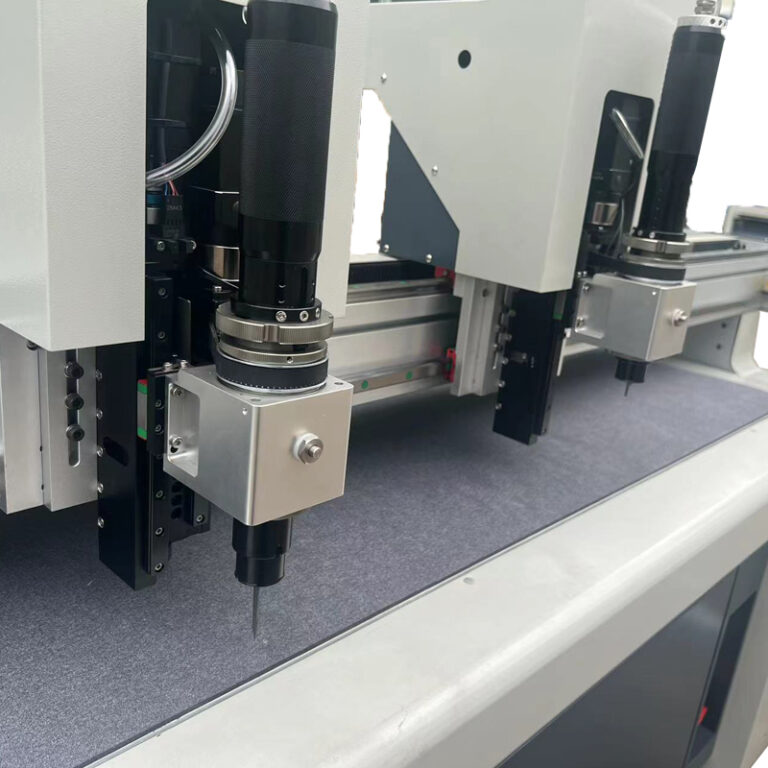
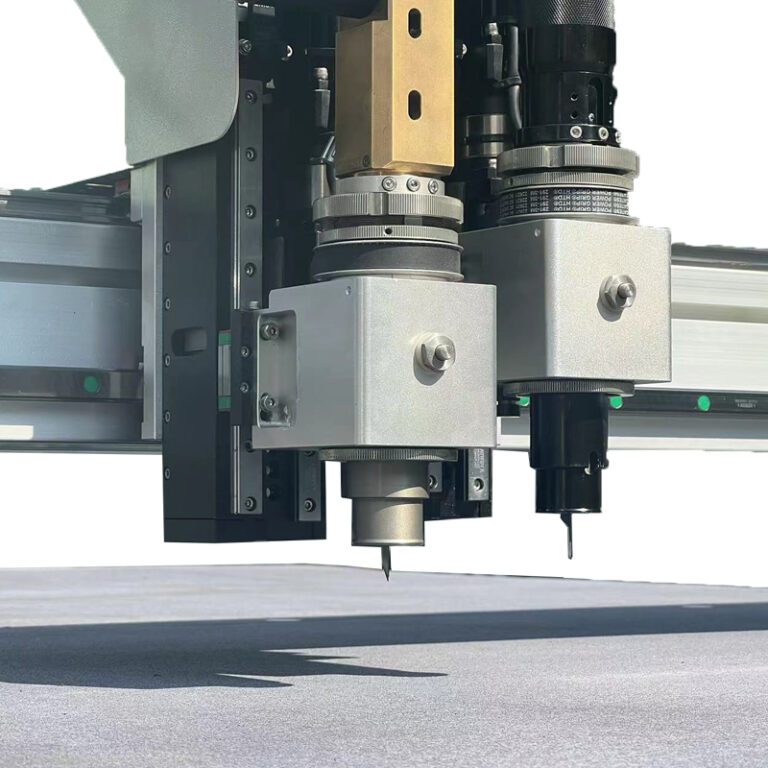
A multi-material cell may need cutting, punching and marking tools. The purchasing decision should include tool-change time, calibration, software assignment, operator steps and the risk of using the wrong material recipe. Ask the supplier to demonstrate how a job selects the correct tool and how the first part is approved after a changeover.
| Decision | Evidence to request |
|---|---|
| Tool suitability | Why the tool was chosen for that material behavior |
| Edge acceptance | Top, bottom and close-up edge images |
| Depth and profile | Cross-section or side view for thick foam and backed carpet |
| Holding | Unedited video showing the complete cut and active vacuum setup |
| Repeatability | Numbered consecutive parts and critical measurements |
| Workflow | Loading, tool changes, cutting, punching, marking and unloading time |
To connect tool selection with machine configuration, see the automotive interior cutting machine guide, car mat cutting workflow, and JEKE application and material overview.
How JEKE can support an automotive interior test
JEKE develops digital cutting solutions for automotive carpet, floor mats, trunk mats, seat leather, headliner, felt, non-woven fabric, acoustic material, thermal insulation and other interior composites. Configurations may combine different cutting, punching, marking, feeding, vacuum and vision options. Actual compatibility and quality depend on the production material and agreed test.
Send your automotive interior samples to JEKE with the material construction, thickness, largest part, smallest feature, required operations and acceptance standard.
Frequently asked questions
Can one oscillating blade cut carpet, felt, foam and leather?
One tool family may cover several materials, but the blade, stroke, force, depth and settings may differ. Some materials or operations may be better served by another tool. Test the actual material instead of assuming one blade is universal.
Is maximum cutting thickness the main selection criterion?
No. Density, hardness, backing, contour, edge requirement, blade deflection and holding may be more important than nominal thickness.
Should cycle time include tool changes?
Yes, when the production mix requires multiple tools or material recipes. A path-only time can underestimate the real job time.
What if a material moves during the test?
Record the direction and point of movement, then check vacuum coverage, leaks, table condition, material porosity, cutting force and path sequence. Do not compensate only by slowing the machine without finding the cause.
Sources and further reading
- Zünd: Modules and tools guide for leather, felt, foam, cardboard and textiles
- Zünd: Oscillating-tool application guide by material and thickness
- Zünd: Digital cutting applications for interiors
Last reviewed: August 20, 2026.